

A relatively new prime lamb breed to Australia is paying big dividends for Furner farmers Michael and Amber Buhlmann, allowing them to run more ewes and produce more lambs per hectare.
For the past seven years, the couple has been transitioning their Merino and first-cross ewe flock to Kiranda Maternal (formally known as Highlanders).
This breed was developed in New Zealand with a focus on the key traits that are important in a naturally productive self-replacing meat sheep flock.
The Kiranda Maternal ewe is renowned for being low maintenance and naturally fertile, rearing healthy, fast-growing lambs.
“The ewe’s medium frame size means a lower feed requirement, which leads to better pasture utilisation, higher stocking rates, fewer animal health issues and ease of management,” Mr Buhlmann said.
The Buhlmanns source maternal and terminal composite rams from Damien Croser’s Kiranda stud, which is based at Penola.
The stud’s maternal stabilised composites – predominantly based on Romney, Texel and Finn genetics – are a highly efficient animal that aims to drive flock profitability with a moderate adult weight of 65-70 kilograms while weaning up to 180 per cent lambs.
Mr Buhlmann said the Kiranda maternal and terminal sires delivered higher lamb output per hectare by producing a big ratio of twin lambs, with few singles or triplets.

He said these fast-maturing lambs could achieve a trade market carcase weight of 24-26kg within 20-22 weeks.
“The Kiranda-sired lambs are born with ease, have high vigour for fast delivery to market and maintain a consistent fat cover of eight millimetres throughout their growth cycle,” he said.
The Buhlmanns run 2750 ewes on their farm near Millicent, along with 120 Angus cows.
There are 25-35 hectares of dryland fodder crops grown annually for summer lamb finishing.
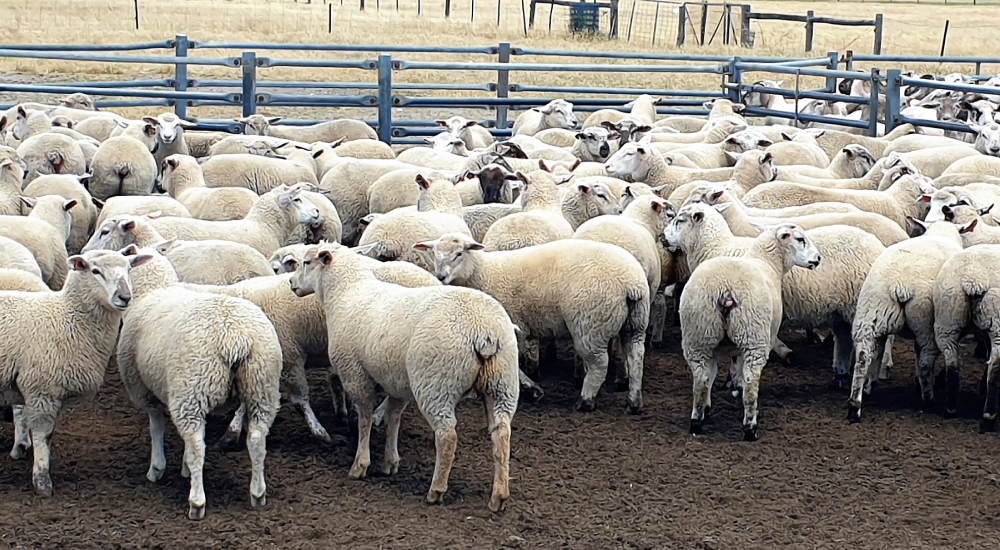
Their ewes are highly fertile, with only 2pc being dry at scanning and delivering marking rates of 150-160pc. “But we are aiming to achieve a 170-80pc marking rate as the flock becomes more genetically pure in coming years,” Mr Buhlmann said.
“We are still in the transition phase with fertility, and firmly believe we can continue to make improvements in lifting rates from scanning to marking.”
Mr Buhlmann said Kiranda Maternal ewes were easy to manage, especially at lambing when they did not need monitoring, and ewe losses were only ever about 0.5pc.
“That has been a welcome change from the consistent observation needed for first-cross and Merino ewes,” he said.
“The Kiranda Maternal are a highly efficient, profitable and successful sheep breed for us here.”
The Buhlmanns run their twin-bearing ewes in small mobs of about 120-150 head after scanning and use a stocking rate of about four to seven ewes per hectare to get lambing rates of 160-180pc.
“There is a clear correlation between the number of ewes to the hectare, mob size and paddock size having a direct effect on marking results, and we are continuing to work on improving the outcome at marking,” Mr Buhlmann said.
He said they had two matings – a late December to January period for a lamb drop in June and a February-March period for lambing in August.
Mr Buhlmann said this allowed them to maximise the number of pregnant ewes on the property year-round for higher productivity.
He said it also made the most of the biggest feed flushes in late winter and spring and the use of the fodder brassica crops during the summer months.
Lambs are sold when they hit a carcase weight target of about 25kg, which is anywhere from five-months to eight-months-old.
The first batches of June-born lambs are sold in November-December after being finished on spring pastures, and August-born lambs start being sold about January after grazing fodder crops.
Lambs are weighed at weaning and then continually weighed and monitored in the lead-up to either a sale or joining.
“We are achieving growth rates of about 280 grams per day on pasture and 300g/day on fodder crops,” Mr Buhlmann said.
He said there was limited carcase feedback on lambs from processors in Australia, but the New Zealand experience was the combination of Primera over Highlander sheep was especially valued for good intramuscular fat and a range of other key meat-eating quality traits.
“Kiranda Maternal and Prime are a continuation of these New Zealand breeds,” he said.
Mr Buhlmann consults with Bayden Wilson in relation to his flock breeding program and the service includes guaranteed ram supply.
Mr Croser drafts the rams into tiers based on Australian Sheep Breeding Values, putting up a consistent group for clients to individually select from.
Mr Buhlmann then simply makes his sire selection on desired visual characteristics.
Visit Kiranda’s website to learn more: www.kiranda.com.au
Rams are currently for sale via selection by appointment.
Contact: Damien Croser
Phone: 0428 846 300
Email: Kiranda@bigpond.com

Original article written by the Stock Journal:
September 25 2022
https://www.stockjournal.com.au/story/7905063/ewe-beauty-kiranda-maternals-deliver-on-farm/
Adopted by Kiranda
December, 2024.